
What Are the 2026 Top LED Ceiling Light Types?
The 2026 Led Ceiling Light market is moving beyond simple brightness. Homeowners now expect lower energy use, cleaner design, and better control. The U.S. Department of Energy reports that LED products can use at least 75% less energy than incandescent lighting. They can also last up to 25 times longer. These figures explain why LED ceiling fixtures remain central to residential and commercial projects.
The leading types include ultra-thin flush mounts, recessed downlights, edge-lit panels, adjustable gimbal lights, and smart ceiling fixtures. Flush mounts suit low ceilings and narrow hallways. Recessed models create focused pools of light above kitchen islands. Edge-lit panels produce soft, even illumination across offices and bedrooms. Smart versions add dimming, scheduling, and voice control. Small details matter, such as glare at eye level, color rendering on wooden floors, and flicker during evening use.
Dr. Nadarajah Narendran, a recognized solid-state lighting researcher at Rensselaer Polytechnic Institute, has described LEDs as “a fundamentally different light source.” That observation still matters in 2026. A Led Ceiling Light is not merely a bulb replacement. It is a complete lighting system involving optics, heat management, controls, and installation quality. ENERGY STAR guidance also stresses efficient performance and dependable testing. Yet not every new fixture deserves attention. Some designs look impressive but produce harsh shadows or difficult repairs. This guide examines the strongest 2026 types, while questioning whether smarter always means better.
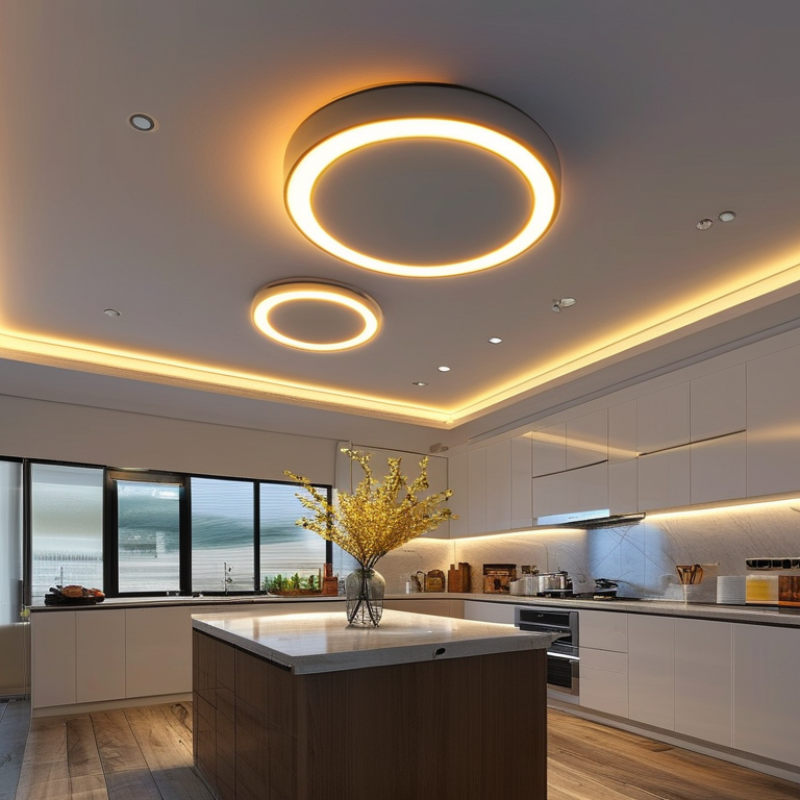
Flush-Mount LED Lights: 100–150 lm/W for General Residential Lighting
What Are the 2026 Top LED Ceiling Light Types?
Flush-Mount LED Lights: 100–150 lm/W for General Residential Lighting
Flush-mount LED lights remain a practical choice for bedrooms, hallways, kitchens, and compact living rooms in 2026. Their low-profile housing sits close to the ceiling, making them suitable for spaces with limited headroom. Many current models deliver between 100 and 150 lumens per watt under tested conditions. That efficiency can reduce energy use without creating a bulky visual feature.
The number matters, but it does not tell the whole story. A 1,200-lumen fixture may adequately illuminate a small bedroom, while a larger kitchen needs stronger and more evenly distributed light. Look for a color rendering index of 80 or higher for ordinary residential use. A rating above 90 can make wood, fabrics, and food appear more natural. Warm white, around 2700–3000K, often feels comfortable in bedrooms. Neutral white, near 3500–4000K, can suit work areas.
Check the driver quality, dimming range, glare control, and rated lifetime. These details affect daily comfort. In practice, a highly efficient fixture may still feel harsh if its diffuser creates bright spots. The 100–150 lm/W figure can also change with color temperature, operating heat, and testing conditions. It looks precise on paper, but real rooms are less controlled. Measure the ceiling height and room size before choosing output. A slim light that fits beautifully may still leave dark corners.

Recessed LED Downlights: 90+ CRI and 2700–4000K CCT Options
Recessed Led Downlights are becoming a leading ceiling-light choice in 2026. Their clean trim sits almost flush with the ceiling, while directional optics place light exactly where it matters. The U.S. Department of Energy reports that LED lighting can use at least75% less energy and last up to 25 times longer than incandescent lighting. That efficiency matters in kitchens, corridors, and rooms with long daily operating hours.
A CRI of 90 or higher gives materials a more natural appearance. Skin tones look less gray, red fabrics appear richer, and timber keeps its warmer character. The 2700–4000K CCT range adds practical flexibility. Use 2700K for bedrooms and hospitality spaces. Choose 3000K for living areas. Select 3500–4000K for workrooms, kitchens, and circulation zones. ENERGY STAR performance guidance commonly sets CRI 80 as a baseline, so 90+ CRI represents a more demanding visual target.
IES lighting guidance also stresses illuminance, glare control, and visual comfort, not only color quality. A narrow beam may create bright ceiling spots. A wide beam can appear weak. My own design checks often reveal this mistake: high CRI cannot repair poor spacing. Review beam angle, mounting height, dimming compatibility, and delivered lumens together. The U.S. DOE Solid-State Lighting reports continue to emphasize better efficacy, controls, and color consistency, yet product claims still need independent testing. Ask for LM-79 photometric data and LM-80 lumen-maintenance evidence before specifying a fixture.
LED Panels and Troffers: 100–160 lm/W for Offices and Commercial Spaces
What Are the 2026 Top LED Ceiling Light Types?
LED panels and troffers remain practical choices for offices, schools, clinics, and commercial interiors. Many current fixtures deliver about 100–160 lm/W, depending on the driver, optics, color temperature, and dimming system. That range can reduce energy use while maintaining clear, even illumination across desks and walkways.
Panels create a smooth ceiling appearance with fewer visible bright spots. Troffers can provide stronger directional control, especially in spaces with rows of workstations. In real installations, glare matters as much as efficiency. A bright fixture may still cause eye fatigue when screens reflect its diffuser. I have seen layouts meet the lighting target yet feel uncomfortable by afternoon. The calculation was correct. The experience was not.
Tips: Check delivered lumens, not only wattage. Compare glare ratings, warranty terms, flicker performance, and emergency compatibility. Keep panels aligned with desk rows when possible. Leave space for maintenance access. A small mock-up can reveal shadows, reflections, and uneven brightness before a full installation. Also, do not assume 160 lm/W is always better. Higher efficiency may involve a different diffuser or lower visual comfort, which deserves a careful review.
Smart LED Ceiling Lights: 2700–6500K Tunable White and App Connectivity
What Are the 2026 Top LED Ceiling Light Types?
Smart LED ceiling lights are becoming practical choices for bedrooms, kitchens, and compact offices. Their 2700–6500K tunable white range changes the room’s atmosphere without replacing the fixture. Warm 2700K can soften evening lighting. Cooler 4000–6500K may improve focus during daytime tasks. However, maximum brightness and color accuracy still vary between models. A high color rendering index is useful for kitchens, dressing areas, and workspaces.
App connectivity adds flexible control from a phone or tablet. Users can adjust brightness, set schedules, create wake-up scenes, or link lighting with approved home systems. Check whether the light uses Bluetooth, Wi-Fi, or both. Bluetooth may work locally, while Wi-Fi usually supports remote access but depends on network stability. Small detail. Review permissions and update settings before daily use.
Installation quality matters more than clever features. The ceiling box must support the fixture, and wiring should be checked by a qualified professional when needed. In a real room, the lowest color temperature may feel too yellow beside daylight. That mismatch is easy to overlook. A better approach is testing several settings at night and during cloudy daytime conditions. App controls can also feel slower than a wall switch, especially after a router restart. Smart does not always mean simpler.
Dimmable LED Fixtures: 10–100% Dimming Range with 50,000-Hour Lifespan
In 2026, dimmable LED ceiling fixtures remain a practical choice for homes, offices, and hospitality spaces. Their strongest feature is flexible brightness, often from 10% to 100%. At full output, a kitchen can feel clear and task-ready. At 10%, a hallway becomes softer without feeling abandoned. This range supports changing routines, daylight levels, and personal comfort. Still, low-end dimming is not identical across every installation.
A reliable fixture pairs its LEDs with a compatible dimmer and a well-tested driver. Flicker, buzzing, or delayed response can appear when these parts do not communicate properly. Professional installers check load limits, wiring, ventilation, and control compatibility before finishing the ceiling. They also measure light at the working surface, not only under showroom conditions. A rated lifespan of 50,000 hours sounds impressive, and it helps with maintenance planning. It does not mean the fixture will perform perfectly for 50,000 hours. Heat, dust, voltage variation, and frequent switching may reduce real-world life.
For bedrooms, slim flush mounts with warm-white output can create calm, even illumination. Kitchens may benefit from brighter panels or recessed fixtures that reduce counter shadows. I would not choose by lifespan alone. Glare control, color consistency, and accessible replacement parts matter too. Small details matter. A dimmer reaching 10% on paper may appear closer to 20% in a dark room. Testing the fixture at night is worthwhile. The best ceiling light dims smoothly, stays quiet, and suits the room’s actual use.

