
" "

Blog

Top Hand Manual Coffee Grinder Manufacturers in China

Coffee drinkers increasingly expect control over every step, from bean selection to the final pour. A Hand Manual Coffee Grinder offers that control without electricity, but performance depends on more than a polished exterior. Burr alignment, adjustment consistency, handle stability, and ease of cleaning all shape the daily experience. Small details matter.

The International Coffee Organization’s Coffee Report and Outlook, published in 2024, estimated global coffee consumption at about 177 million 60-kilogram bags for the 2023/24 coffee year. This figure describes coffee demand, not grinder sales. Still, it provides useful context: a large, diverse coffee market creates varied expectations for home and travel equipment. China-based manufacturers serve this category through different designs, materials, and production capabilities, so buyers should assess each supplier rather than rely on country of origin alone. Ask for clear burr specifications, sample units, and evidence of repeatable quality checks. Then test the grinder with the same beans and brewing method you use at home. A smooth crank is not enough. Some product descriptions still blur measurable performance with attractive claims; that deserves scrutiny. This guide introduces leading Hand Manual Coffee Grinder manufacturers in China and the practical factors that can help buyers compare them.
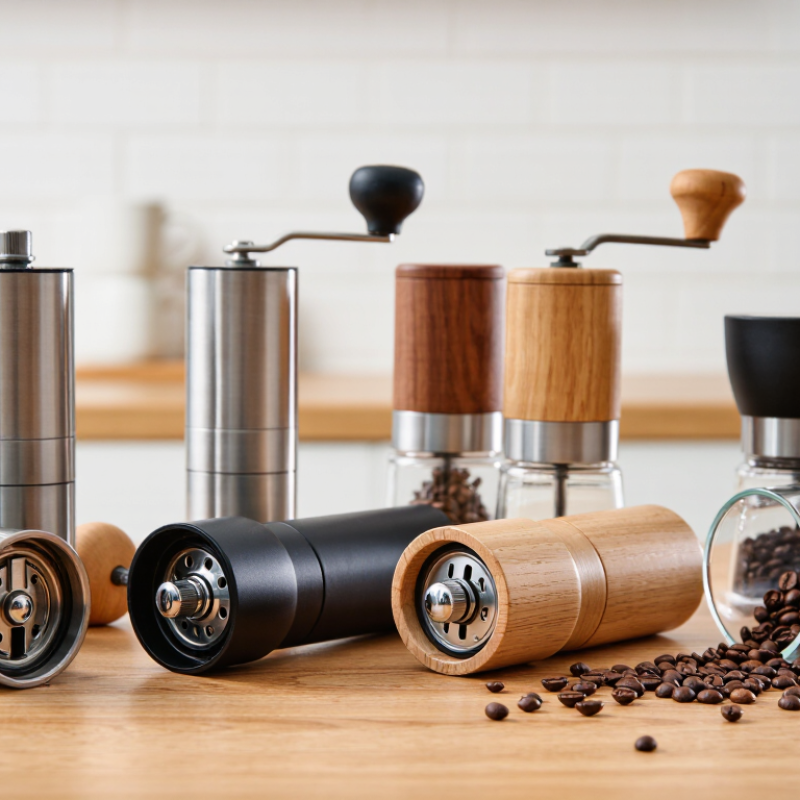
Top Hand Manual Coffee Grinder Manufacturers in China

Understanding Hand Manual Coffee Grinders and Their Core Components

A hand manual coffee grinder converts wrist movement into controlled burr rotation. Its core parts are the burr set, central shaft, bearings, adjustment mechanism, handle, and grounds cup. The burrs break beans into particles; their alignment affects how evenly those particles are sized. A stepped adjustment ring makes repeatable changes easier, while a loose shaft can cause wobble and uneven grinding. Fit matters. The Specialty Coffee Association’s Golden Cup Brewing Standard gives a target extraction yield of 18–22% and beverage strength of 1.15–1.35% total dissolved solids. These figures do not rate grinders, but they help explain why particle consistency matters.

The handle’s length influences leverage, especially with dense, light-roasted beans. Bearings support smoother rotation, though poor assembly can still create friction. A close-fitting grounds cup helps limit spills, but capacity and cleaning also matter in daily use. The International Coffee Organization estimated global coffee consumption at 177.0 million 60-kilogram bags in coffee year 2023/24. This is broad market context, not a measure of hand-grinder sales. When assessing a manufacturer’s sample, check burr wobble, adjustment repeatability, and the grounds left inside after grinding. Not glamorous. User technique, bean age, and brewing method also affect the cup; a grinder alone cannot guarantee identical results.

China’s Coffee Grinder Manufacturing Industry

China’s coffee grinder manufacturing industry combines machining capacity with a broad network of metal, plastic, and packaging suppliers. This ecosystem can support hand grinders with stainless steel burrs, aluminum bodies, adjustable settings, and compact travel designs. Production methods vary, so a similar appearance does not guarantee similar performance. Small details matter.

For buyers, useful checks include burr alignment, adjustment consistency, handle stability, and the feel of the grind dial. Ask how samples are tested and whether production units follow the same inspection steps. A grinder that feels smooth once may develop uneven adjustment or excess play after repeated use. That can be overlooked. Material descriptions also deserve verification: a listed metal grade or coating should match the actual component, not just the sales sheet.

Manufacturers may offer custom finishes, packaging, or component changes, but each change can affect assembly and quality control. Clear drawings and agreed sample tolerances reduce confusion, especially for small parts. Price alone is a weak measure of factory capability. A more reliable assessment considers communication, repeatability, and how openly a supplier discusses defects or limitations. Even then, a first order cannot reveal every issue; ongoing inspection remains sensible.

Top Hand Manual Coffee Grinder Manufacturers in China

Commonly specified burr diameters in hand coffee grinders

These are examples of burr diameters found in hand-grinder product specifications, not market-share or production data. The chart does not represent a China-specific manufacturer survey.

Materials, Production Methods, and Quality Standards

A dependable hand grinder starts with materials suited to repeated contact and daily use. Stainless steel burrs resist wear, while aluminum bodies keep the tool lighter. Some manufacturers use stainless steel housings for added durability, though they can feel heavier in the hand. Food-contact parts should have traceable material specifications. Small details matter: a smooth, burr-free catch cup is easier to clean.

Production often combines CNC machining, casting, and hand assembly. Machining helps control shaft alignment and burr spacing; assembly workers then check the crank, bearings, and adjustment ring.

Listen for scraping. It can reveal poor alignment.

Quality checks should include grind tests at several settings, handle-load checks, and inspections for corrosion or sharp edges. Manufacturers can record results by batch and retain samples for comparison.

Buyers may ask for material records, inspection criteria, and test data rather than relying on a polished finish or a single sample. Even careful processes have limits: burr sharpness and grind consistency can vary between batches, so repeat testing matters.

Profiles of Leading Hand Grinder Manufacturers in China

China’s hand grinder manufacturers often serve different production needs. Some focus on compact models for travel, using folded handles and lightweight bodies. Others build heavier grinders with steel frames, larger burrs, and finer adjustment steps. These differences affect durability, portability, and how easily users can repeat a grind setting. Small details matter. Check the axle for side-to-side movement, and turn the handle slowly to feel for uneven resistance.

A capable manufacturer should explain burr material, adjustment design, and inspection procedures in clear terms. Ask for samples from more than one production run, then compare grind consistency and handle alignment. Request test records where available, but verify claims through hands-on checks. A polished sample can still hide variation between units. That part is easy to overlook. Some factories offer custom finishes or packaging, while others prioritize stable specifications and larger production volumes. Neither approach is automatically better; the right fit depends on order size, target use, and quality-control needs. Even a useful profile has limits, so buyers should confirm lead times, replacement-part support, and sample performance before committing.

Top Hand Manual Coffee Grinder Manufacturers in China - Profiles of Leading Hand Grinder Manufacturers in China

This overview compares common manufacturer and product profiles rather than naming or ranking individual companies. Specifications and available services vary by supplier and model.

Manufacturer Profile Typical Product Focus Common Construction Options Adjustment and Grinding Features Manufacturing and Supply Capabilities Key Buyer Checks
Portable Grinder Specialist Compact hand grinders designed for travel, camping, and small kitchens. Often combines a metal body or frame with a removable handle and a grounds container; exact materials differ by model. Manual adjustment is common. Check whether the adjustment steps are repeatable and whether the handle can be stored securely. May offer retail-ready models and packaging options; confirm minimum order quantities and customization availability directly. Overall dimensions, weight, handle stability, ease of disassembly, and replacement-part availability.
Everyday Home Grinder Producer General-purpose grinders for routine home brewing, including pour-over and other manual methods. Common options include stainless-steel burrs and metal or polymer exterior components; construction should be checked against the specific product specification. Typically offers adjustable coarseness settings. Ask for a grind-range demonstration across the brewing methods targeted. May support standard product runs and private-label packaging, subject to the supplier’s production capabilities. Burr alignment, grind consistency, adjustment repeatability, assembly quality, and inspection criteria.
Precision-Oriented Grinder Producer Higher-specification manual grinders for buyers prioritizing grind control and repeatable brewing results. May use machined metal components and conical burr assemblies; material grade and tolerances are model-specific and should be documented. Fine adjustment control and stable burr positioning are important features to verify through samples and testing. Ask whether the supplier can provide engineering drawings, sample units, and documented quality-control procedures. Burr runout and alignment, adjustment range, sample-to-sample consistency, and long-term parts support.
OEM / ODM Grinder Manufacturer Contract production or product development for importers and coffee-equipment brands. Configuration may be selected from existing designs or developed to an agreed specification; materials depend on the approved bill of materials. Design options may include different burrs, adjustment systems, handles, and grounds containers, depending on tooling and engineering scope. Confirm OEM/ODM scope, tooling ownership, packaging support, production lead time, and order requirements in writing. Written specifications, approved samples, change control, quality inspection, compliance documents, and warranty terms.
Value-Focused Manual Grinder Producer Entry-level products for price-sensitive retail, promotional, or introductory coffee equipment ranges. May combine metal grinding components with economical exterior materials. Verify food-contact materials for the intended market. Basic manual coarseness adjustment is common; assess whether the mechanism remains secure during use. Potentially suited to standard models and larger-volume orders; capacity and lead times require supplier confirmation. Sample performance, burr material, food-contact documentation, packaging protection, and defect-handling process.

How to Evaluate and Select a Chinese Grinder Manufacturer

Top Hand Manual Coffee Grinder Manufacturers in China

How to Evaluate and Select a Chinese Grinder Manufacturer

The International Coffee Organization’s December 2023 Coffee Report and Outlook projected global coffee consumption at 177 million 60-kilogram bags for 2023/24. That demand makes dependable grinder production important, but market growth alone says little about a factory’s capability. Ask for inspection records, production capacity, and evidence that sample quality matches later batches.

For a hand grinder, examine burr alignment, shaft runout, adjustment consistency, and handle stability. Request particle-size test results using a stated method, not just claims of “uniform grinding.” Ask how the factory controls burr hardness and surface finish, and whether it can trace materials by batch. A useful audit includes a real production line, calibration tools, and finished units you can inspect—not only polished showroom samples.

ISO’s Survey 2023 recorded more than 1.2 million ISO 9001 certificates worldwide. Certification can indicate a documented quality system, but it does not prove grinder performance. Test several units across coarse and fine settings; note wobble, grind retention, and adjustment drift. Small defects matter. No checklist catches everything. Be wary of unusually tight tolerances without measurement reports, and confirm packaging protects burrs during shipping. A factory may pass an audit and still need closer follow-up.